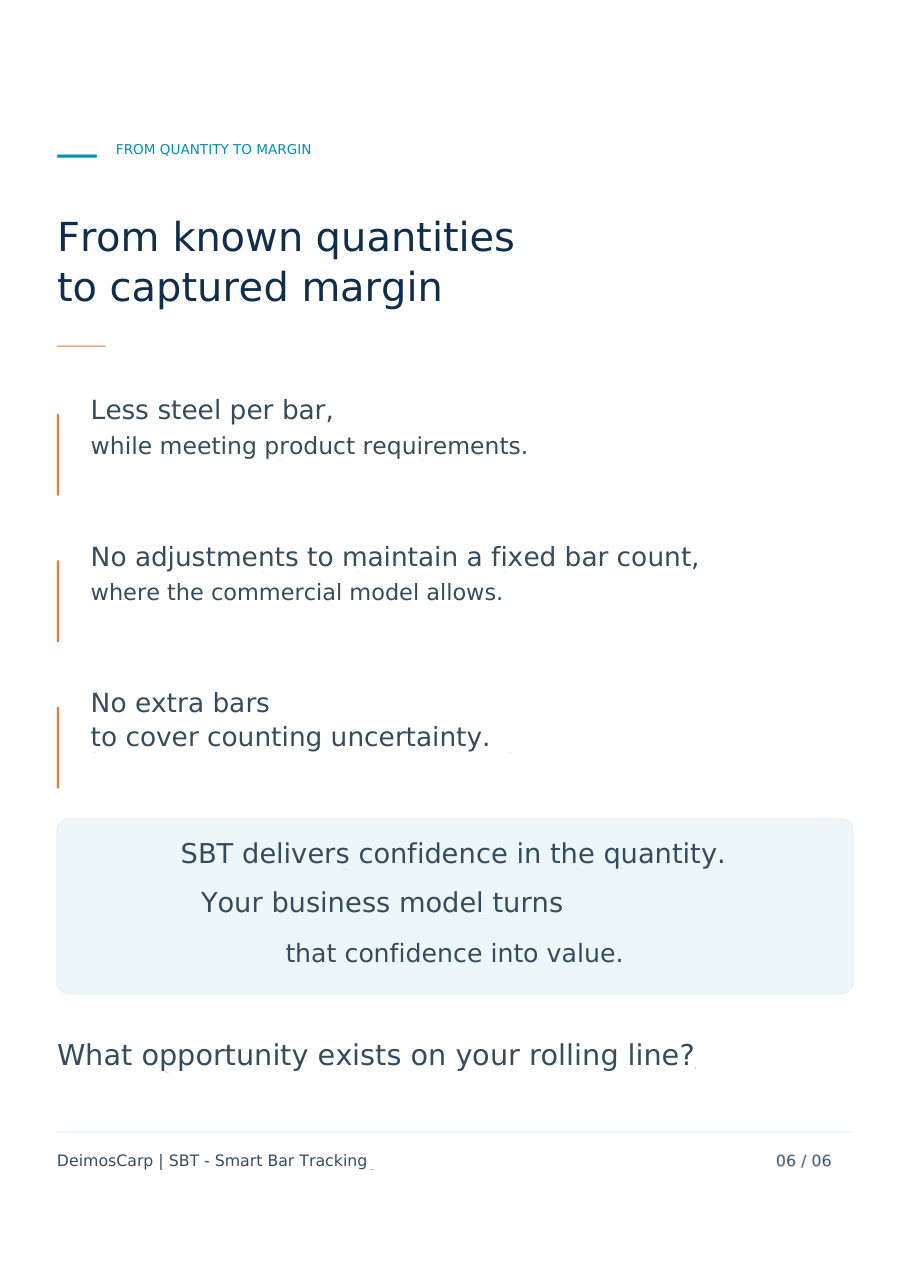
In the global market for long rolled steel products, especially rebar and light sections, three of the main commercial models stand out: actual weight, theoretical weight and number of bars.
Model 1 — Sales by actual weight
The steelmaker bills by measured weight. The distributor resells by the bar and wants more bars per tonne (for example 225 bars at 0.400 kg/m versus 230 bars at 0.390 kg/m), which means lower linear mass and higher production costs. The steelmaker needs to protect its margin.
Solutions used to address the problem: sales by theoretical weight or sales by bar. Estimated financial gain from changing the commercial model: production capacity of 500,000 t/year, estimated gain of US$ 2.5 million/year.
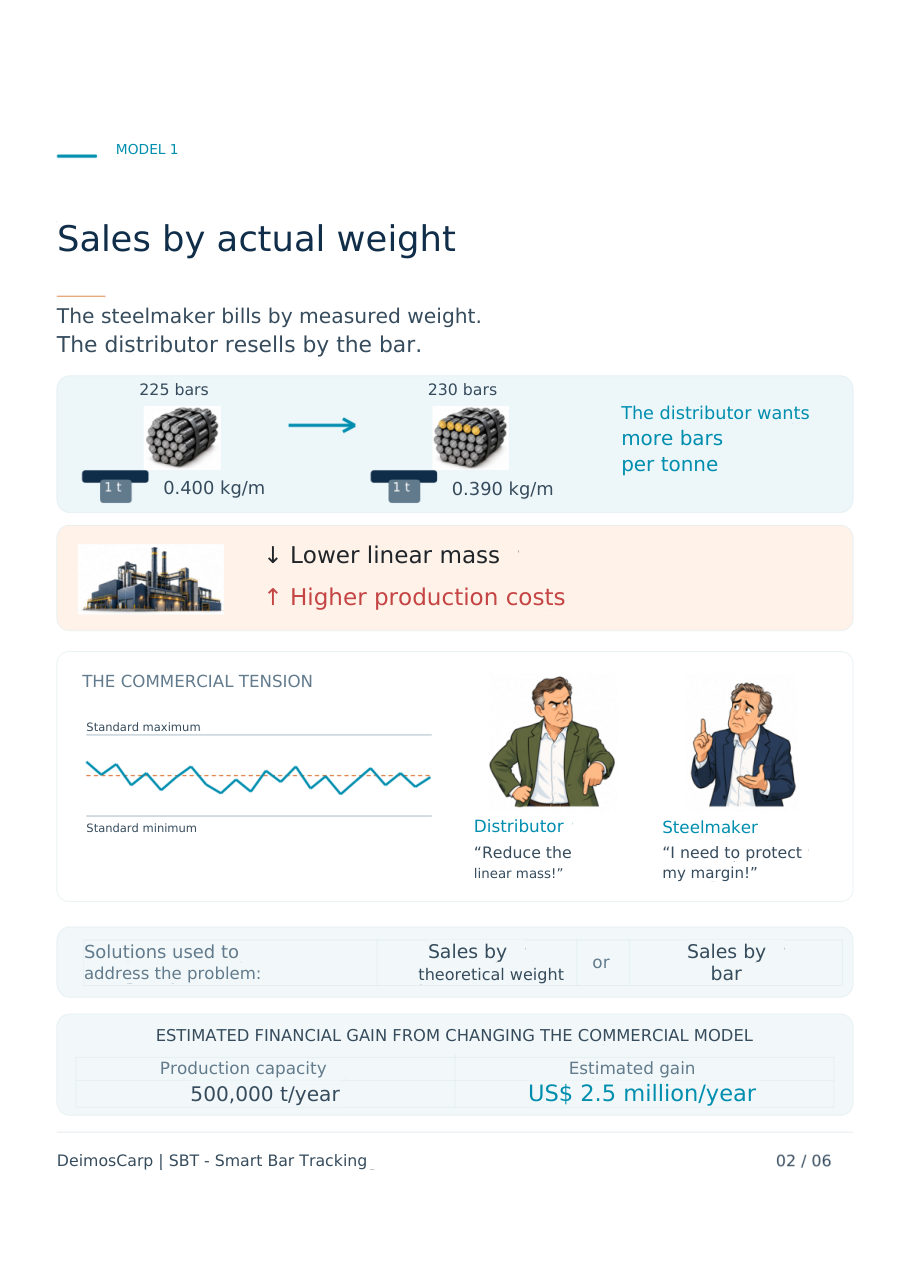
Model 2 — Sales by theoretical weight
A solution that captures gains from lower linear mass while accommodating potential counting variability. The price per tonne is set and the number of bars must fall within an agreed range (for example, 149 to 154 bars per bundle). The steelmaker can target the minimum linear mass allowed by the standard: the same number of bars, using less steel. In this model, gains can pay for CAPEX and Six Sigma projects to reduce linear mass.
Potential challenges: inaccurate counting may trigger complaints when quantities fall below the agreed minimum or the quantity stated on the label (proposed solution: add extra bars to smaller-diameter bundles, where counting is more prone to error), and physical constraints on delivering exactly the minimum quantity.
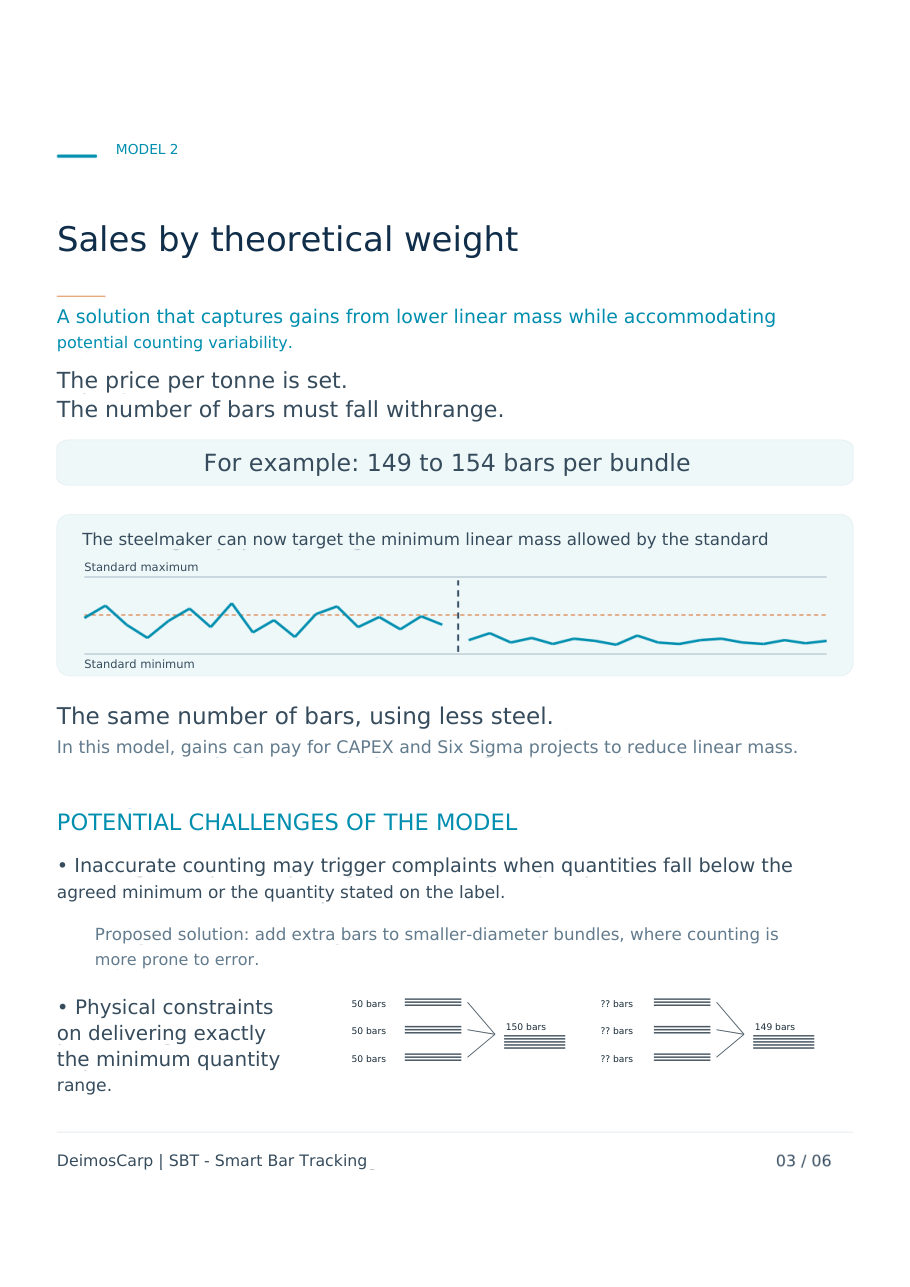
Model 3 — Sales by the bar
The customer pays for the number of bars invoiced: 148 bars, invoice 148; 152 bars, invoice 152. This model overcomes the need for repeatability — maintaining the same number of bars in every bundle — and eliminates the need for bar-separation equipment or crews.
Potential challenge: inaccurate counting may trigger complaints when quantities fall below the agreed minimum or the label quantity. Proposed solution: add extra bars to smaller-diameter bundles. For example, 152 bars delivered and 150 invoiced leaves 2 extra bars with no corresponding revenue.
SBT's contribution
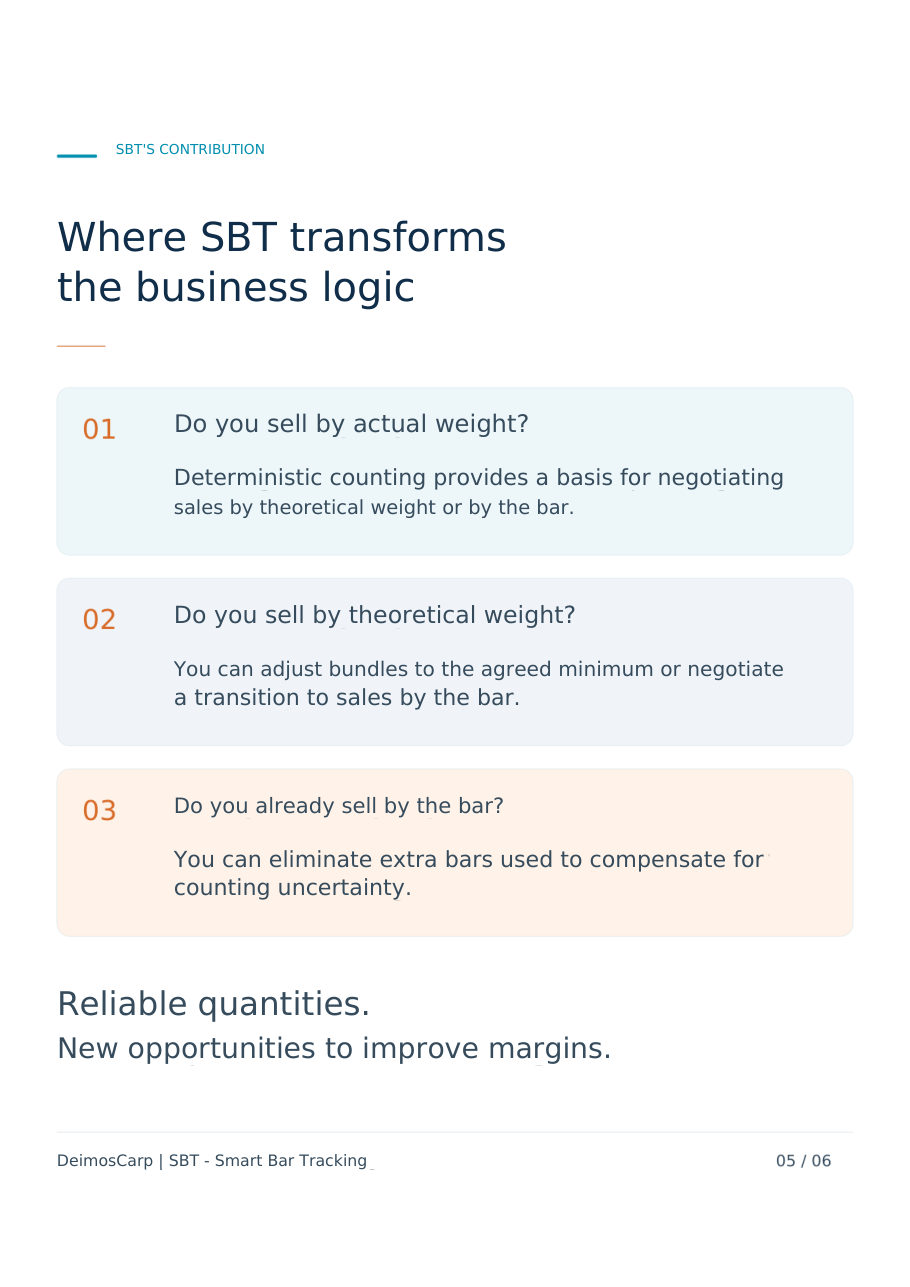
Do you sell by actual weight? Deterministic counting provides a basis for negotiating sales by theoretical weight or by the bar. Do you sell by theoretical weight? You can adjust bundles to the agreed minimum or negotiate a transition to sales by the bar. Do you already sell by the bar? You can eliminate extra bars used to compensate for counting uncertainty.
Reliable quantities. New opportunities to improve margins.
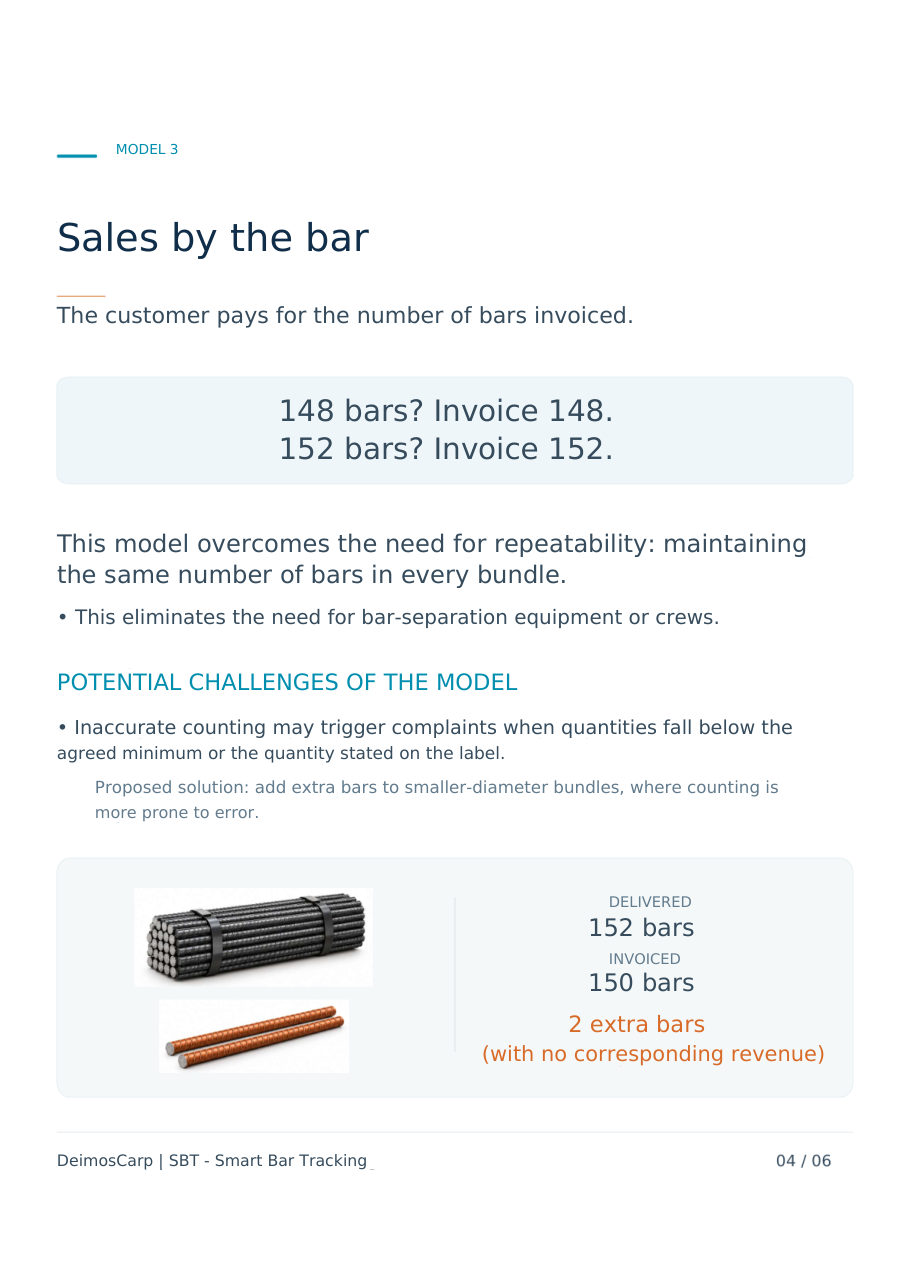
From quantity to margin
Less steel per bar, while meeting product requirements. No adjustments to maintain a fixed bar count, where the commercial model allows. No extra bars to cover counting uncertainty.
SBT delivers confidence in the quantity. Your business model turns that confidence into value. What opportunity exists on your rolling line?